
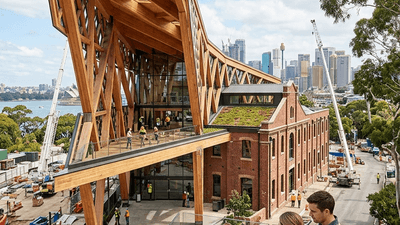



Australia’s built environment is defined by a central, inescapable tension: the desire to connect intimately with a landscape that is, by its very nature, unforgiving. Coastal salt, driving winds, extreme UV exposure, and fluctuating humidity demand materials and methodologies that do more than just survive—they must age gracefully. For Australian architecture professionals, the challenge is no longer just about designing for aesthetic impact; it is about synthesizing material resilience, verifiable sustainability, and cutting-edge technology to future-proof our cities and coastlines.
As we navigate the complexities of modern practice, three distinct yet interconnected trends are dominating the conversation: the sophisticated application of native, resilient timbers; a regulatory and cultural pivot toward adaptive reuse; and the rapid integration of artificial intelligence in design workflows. Together, these forces are redefining what it means to build responsibly in Australia.
The Coastal Crucible: Material Resilience at Normanville
To understand the current trajectory of material specification in Australia, one need look no further than the recent completion of the Normanville Beach House in South Australia. Perched on a rugged coastline, the project is a masterclass in specifying for extreme environmental stress without sacrificing biophilic warmth.
As detailed in a recent showcase on Australian hardwood applications, the home relies heavily on a dual-timber strategy. Internally, Australian Oak provides a refined, continuous warmth that softens the coastal glare. Externally, the architects specified IronAsh—a treated eucalypt hardwood renowned for its high durability and resistance to decay, termites, and coastal weathering.
The success of the Normanville Beach House lies in its seamless threshold between the interior and exterior. By utilizing visually complementary but functionally distinct timber profiles, the architects achieved a cohesive aesthetic that meets the rigorous demands of the coastal environment. It is a powerful reminder that material selection must be deeply contextual.
The Chain of Custody: Why Certification is Non-Negotiable
While the aesthetic and structural benefits of timber are well-documented, the modern architect's responsibility extends far beyond the site boundary. The sourcing of these materials has become a critical focal point for both regulatory bodies and environmentally conscious clients.
Across Australia's leading architectural projects, there is a pronounced shift toward mandated material transparency. According to recent industry insights, Australian architects are increasingly insisting on PEFC-certified timber. The Programme for the Endorsement of Forest Certification (PEFC) provides a verifiable chain of custody, assuring practitioners that the timber they specify is harvested sustainably, respecting both ecological limits and Indigenous land rights.
The Practical Imperatives of Certified Timber
- Risk Mitigation: Specifying certified timber protects practices from the reputational damage associated with illegal logging and unethical supply chains.
- Client Expectations: Institutional and high-net-worth clients now view ESG (Environmental, Social, and Governance) compliance as a baseline requirement, not a premium add-on.
- Green Star Ratings: Certified timber directly contributes to higher Green Star and NABERS ratings, increasing the long-term asset value of commercial and multi-residential projects.
Building on the Past: The Rise of Adaptive Reuse
While specifying sustainable materials for new builds is crucial, the most sustainable building is often the one that already exists. This ethos is rapidly moving from the fringes to the center of Australian architectural prestige.
The recently revealed 2026 Victorian Architecture Awards shortlist highlights this paradigm shift perfectly. With over 120 entrants named as finalists across 15 categories, the jury has placed a heavy, unmistakable focus on adaptive reuse. Rather than celebrating tabula rasa developments, the industry is rewarding practices that can elegantly untangle and repurpose existing structures.
Adaptive reuse requires a fundamentally different skill set than new construction. It demands an archaeological sensitivity to existing materials, a rigorous understanding of embodied carbon, and the technical acumen to bring heritage structures up to contemporary thermal and structural codes.
Comparing Approaches: New Build vs. Adaptive Reuse
| Consideration | Greenfield / New Build | Adaptive Reuse |
|---|---|---|
| Embodied Carbon | High initial footprint; mitigated over time through operational efficiency. | Significantly lower; capitalizes on the sunk carbon of the existing structural frame. |
| Material Sourcing | Total freedom to specify modern, certified materials (e.g., PEFC timber). | Requires integration of new materials with legacy systems (e.g., matching historical brickwork). |
| Design Flexibility | Unrestricted, allowing for optimized passive solar and spatial planning. | Constrained by existing grids and heritage overlays, requiring innovative spatial problem-solving. |
The Algorithmic Advantage: AI's Role in Modern Practice
Managing the intersection of hyper-specific material demands (like coastal-grade hardwoods), rigorous sustainability certifications, and complex adaptive reuse constraints is an increasingly data-heavy endeavor. To navigate this, Australian practices are turning to the next frontier of architectural technology: Artificial Intelligence.
The conversation around AI in architecture has matured past generative image creation. Today, it is fundamentally altering how projects are analyzed, funded, and delivered. Matthias Hollwich, a leading smart cities expert, recently noted that AI is changing architecture faster than the real estate sector realizes.
"Artificial intelligence is not just a drafting tool; it is a comprehensive analytical partner. It allows us to simulate decades of environmental wear on specific materials, optimize the structural yields of adaptive reuse projects, and provide developers with predictive models that de-risk innovative architectural choices."
For Australian architects, AI offers distinct practical advantages in the current market:
- Material Optimization: AI algorithms can analyze local climate data against timber performance metrics, helping architects specify the exact treatment and profile needed for sites like the Normanville Beach House, minimizing waste.
- Heritage Mapping: In adaptive reuse projects, AI-driven point-cloud scanning and structural analysis can rapidly assess the viability of existing structures, identifying which elements can be saved and which must be replaced.
- Compliance Tracking: AI tools can automatically cross-reference material schedules against PEFC databases and local building codes, ensuring compliance without the exhaustive manual labor previously required.
Looking Ahead: A Synthesized Future
The future of Australian architecture is not a choice between returning to nature or embracing the digital; it is the intelligent synthesis of both. The warmth and resilience of Australian hardwoods, the ethical imperative of certified supply chains, and the ingenuity of adaptive reuse are all being amplified by the analytical power of artificial intelligence.
As professionals, our mandate is clear. We must continue to specify with profound respect for our harsh, beautiful environment, honoring the embodied carbon of the past while leveraging the technologies of the future. The practices that master this synthesis will not only win the awards of tomorrow—they will build the resilient, sustainable Australia we desperately need.