
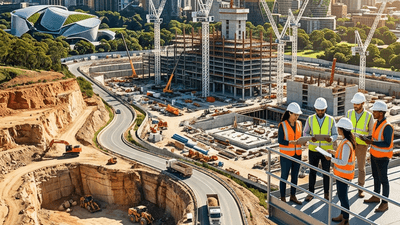



In a former sandstone quarry, fragments of Melbourne's architectural history are quietly taking on a second life. Monash University architecture students have recently taken salvaged materials from past National Gallery of Victoria (NGV) Architecture Commissions and reassembled them into site-responsive installations. On the surface, it is a brilliant academic exercise in adaptive reuse. But look closer, and this quarry becomes a microcosm of a much larger, structural shift currently sweeping through Australian architecture.
We are operating in an era where the logistics of building—how we source, transport, and assemble materials—are dictating design outcomes just as much as aesthetic vision or client briefs. From the grassroots ingenuity of architecture students to the monumental completion of Australia's largest cultural infrastructure project since the Sydney Opera House, the profession is being forced to reconcile high design with hard economic and material realities.
The Supply Chain Reality Check
For the past few years, the Australian construction sector has treated supply chain volatility as a temporary, post-pandemic hangover. In 2026, we must accept it as the new baseline. The Australian Institute of Architects has recently launched a targeted survey to gather critical data on how fuel, transport, and supply-related pressures are impacting architectural practice and project delivery.
This initiative is timely and necessary. Transport costs, driven by fluctuating global fuel prices and domestic logistical bottlenecks, are no longer just a line item on a contractor's spreadsheet—they are actively threatening project viability.
"When the cost of moving a steel beam from port to site rivals the cost of the material itself, the fundamental calculus of how we design must change. Localism is no longer just a sustainable choice; it is an economic imperative."
For practitioners, this means the days of specifying bespoke, heavily imported materials without a robust contingency plan are over. The Institute's survey results will likely confirm what many of us already know: architects are increasingly being forced into value-management processes earlier in the design phase, requiring a deeper, more pragmatic understanding of procurement logistics.
The Next Generation: Circularity as a First Principle
If supply chain pressures represent the problem, the next generation of architects is actively prototyping the solution. The recent Monash University studio project—which saw students repurpose NGV pavilion materials into new quarry installations—demonstrates a vital shift in architectural education.
Historically, architecture schools focused heavily on designing from a blank slate, specifying virgin materials to achieve pure geometric forms. Today, students are learning to design in reverse. By taking salvaged components—materials that already possess distinct dimensions, structural capacities, and histories—and forcing them to respond to the rugged topography of a former sandstone quarry, these students are mastering the art of the circular economy.
Why This Matters for Established Practices
- Material Inventories over Blank Slates: Future graduates will enter the workforce expecting to conduct "material audits" of existing sites before proposing new structures.
- Design Flexibility: Designing with salvaged materials requires a tolerance for dimensional variation, pushing firms toward more modular, adaptable detailing.
- Embodied Carbon Literacy: The next wave of architects views the reuse of an NGV pavilion not just as a fun design constraint, but as a critical carbon-saving measure.
This ideological shift isn't confined to the classroom. The profession is actively rewarding this broader, more resourceful approach to practice. The recent announcement of the 2026 Emerging Architect Prize winners highlights eight chapter winners who are being recognized not just for their built portfolios, but for their significant contributions to advocacy, education, and systemic change within the industry. The leaders of tomorrow are those who can navigate scarcity with innovation.
Scaling Up: The Mega-Project Paradox
While students and emerging architects champion localism and material reuse, how does this philosophy scale to the civic level? The answer lies in Western Sydney, where construction on the $915 million Powerhouse Parramatta is now complete, with fitout underway ahead of its late 2026 opening.
As the largest cultural infrastructure project in Australia since the Sydney Opera House, Powerhouse Parramatta is a triumph of engineering and civic ambition. However, mega-projects of this scale are ground zero for the very supply chain pressures the AIA is currently surveying. Delivering a nearly billion-dollar project in today's economic climate requires an unprecedented level of logistical orchestration.
The completion of Powerhouse Parramatta proves that monumental architecture is still possible, but its legacy will likely be as much about how it was procured as what it looks like. Moving forward, the true test for civic architecture will be its adaptability. Can the mega-projects of 2026 be disassembled, repurposed, or adapted in 2076, much like the NGV pavilions are being repurposed today?
Practical Implications: Redefining the Procurement Playbook
For Australian architecture professionals, the convergence of supply chain volatility, circular design education, and the completion of massive civic infrastructure points to a necessary restructuring of how we practice. The traditional linear model of design and procurement is giving way to a more resilient framework.
| Practice Element | Traditional (Linear) Approach | Emerging (Resilient) Approach |
|---|---|---|
| Material Sourcing | Global supply chains, prioritizing aesthetic exactness. | Hyper-local sourcing, prioritizing availability and salvaged inventory. |
| Design Process | Form dictates material specification. | Material availability and logistics dictate form. |
| Risk Management | Relying on contractor contingencies for transport delays. | Early-stage integration of supply chain analysis into feasibility studies. |
| End of Life | Demolition and landfill. | Design for Disassembly (DfD); viewing buildings as material banks. |
Conclusion: A New Era of Resourceful Architecture
Australian architecture is at a fascinating inflection point. On one end of the spectrum, we have the spectacular realization of Powerhouse Parramatta, a testament to what can be achieved when civic will meets architectural ambition. On the other end, we have students in a Victorian quarry, proving that the detritus of past architectural triumphs can be the foundation for the next.
Bridging these two extremes is the everyday reality of the practicing architect, navigating fuel costs, transport delays, and tightening budgets. The future of our built environment belongs to those who view these constraints not as compromises to their design vision, but as the very parameters that will define the next great era of Australian architecture. By embracing the resourcefulness of our emerging talent and confronting our supply chain realities head-on, we can build an industry that is as resilient as it is remarkable.